Home » The Complete Guide to SIGINT, COMINT, and ELINT & Its Antenna Systems
| The Complete Guide to SIGINT, COMINT, and ELINT & Its Antenna Systems |
| |
|
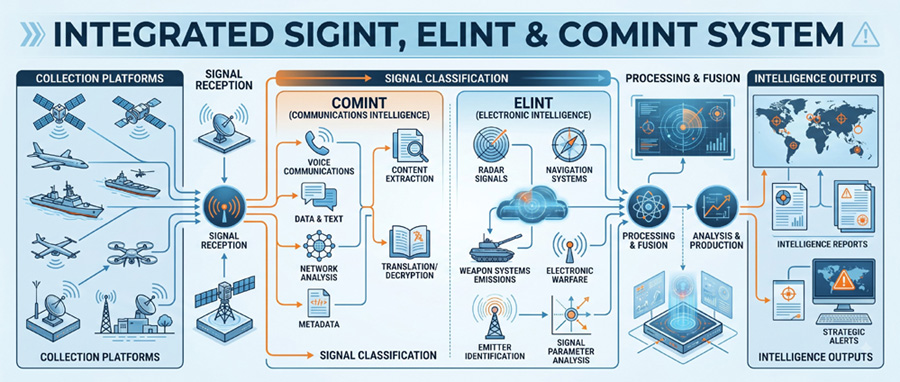
SIGINT, COMINT & ELINT : A Guide for Modern Defense
In the modern landscape of aerospace, defense, and cybersecurity, mastering the electromagnetic spectrum is just as critical as controlling physical territory. To achieve this, intelligence agencies and military operators rely heavily on Signals Intelligence (SIGINT).
While the acronyms can seem like a dense alphabet soup, understanding the technical distinction between SIGINT and its two primary sub-disciplines-COMINT and ELINT-is essential for grasping how modern intelligence is gathered, processed, and weaponized. Before diving into the specifics, explore this interactive breakdown of the intelligence framework to see how these disciplines connect:
What is SIGINT (Signals Intelligence)?
SIGINT is the overarching discipline of gathering intelligence by intercepting electronic signals. It is the umbrella term that houses all methods of electronic interception, providing critical visibility into an adversary's capabilities, disposition, composition, and intentions. SIGINT operations are conducted across various platforms, including unmanned aerial vehicles (UAVs), geostationary satellite constellations, ground monitoring stations, and naval vessels.
What is COMINT (Communications Intelligence)?
COMINT focuses exclusively on intercepted communications between people or groups. If a signal contains human speech or text, it falls under the jurisdiction of COMINT. The primary goal of COMINT is to determine intent. By capturing and decoding these messages, intelligence analysts can uncover what adversaries are thinking, planning, or attempting to hide.
What COMINT targets:
Encrypted and unencrypted military radio transmissions.
Satellite and mobile phone calls.
Text messages, emails, and tactical command chatter.
COMINT systems require highly sensitive receivers and direction-finding (DF) capabilities, often operating in the VHF and UHF bands, with extensions into the HF band for specific long-range missions. Because this data is frequently encrypted, COMINT relies heavily on cryptography and traffic analysis-studying the frequency and location of messages to draw conclusions, even if the raw content cannot be cracked.
What is ELINT (Electronic Intelligence)?
ELINT is the interception and analysis of electromagnetic signals that do not contain human communications. This is a highly technical discipline focused entirely on the electronics of the adversary's hardware. If COMINT reveals intent, ELINT reveals capability and presence. It is fundamentally about listening to the electronic emissions of machines to map out the physical battlefield.
What ELINT targets:
Radar emissions from air defense systems and surveillance networks.
Guidance signals from missiles or drones.
Electronic countermeasure (ECM) systems, such as jamming arrays.
Identification Friend or Foe (IFF) transponder responses.
ELINT is critical for modern air warfare and stealth operations. By geolocating surface-to-air missile (SAM) radars, strike aircraft can plot flight paths to avoid heavily defended zones, or electronic warfare units can deploy specialized jamming signals to achieve a "soft kill" on the radar network.
COMINT vs. ELINT: Key Differences
While both fall under the SIGINT umbrella, they serve entirely different tactical purposes.
| Feature |
COMINT (Communications Intelligence) |
ELINT (Electronic Intelligence) |
| Primary Target |
Human-to-human or human-to-machine communications. |
Machine-to-machine emissions (non-communications). |
| Data Types |
Voice calls, texts, emails, radio chatter. |
Radar pulses, telemetry, missile guidance signals. |
| Strategic Value |
Reveals adversary intentions and plans. |
Reveals adversary capabilities and hardware locations. |
| Analytical Focus |
Cryptography, translation, message metadata. |
Frequency, pulse width, amplitude, direction of arrival. |
The Advantages of Technical Signals Intelligence
Deploying robust SIGINT architectures offers several unparalleled strategic advantages:
1. Early Warning and Intent Prediction:
Unlike Imagery Intelligence (IMINT), which requires waiting for physical movement to be photographed, SIGINT can reveal an adversary's plans before any physical action takes place. An adversary preparing a surface-to-air missile system will emit ELINT signals well before troops visibly mobilize.
2. Electromagnetic Spectrum Dominance:
Modern defense relies heavily on complex C4ISR (Command, Control, Communications, Computers, Intelligence, Surveillance, and Reconnaissance) systems. SIGINT ensures mission continuity by mapping out the electronic threat landscape, allowing forces to deploy anti-jamming measures or neutralize enemy communications.
3. Force Protection:
By pinpointing the exact locations of enemy anti-aircraft artillery and radar networks via ELINT, military commanders can navigate assets away from high-risk zones, protecting personnel and expensive stealth platforms.
What is FISINT?
Foreign Instrumentation Signals Intelligence (FISINT) is the third, lesser-known sub-category of SIGINT. While ELINT focuses on radar and operational electronics, FISINT intercepts signals specifically created during the testing and use of foreign weapons, such as aerospace telemetry, beacons, and video data links.
How do COMINT and ELINT work together?
They are highly complementary. For example, if ELINT detects a sudden surge in radar activity near a border, analysts might initially be unsure of the exact cause. If COMINT simultaneously intercepts encrypted tactical chatter discussing "forward movement" in the same region, the combined intelligence confirms an imminent deployment rather than a routine drill.
Can SIGINT operate effectively without cracking encryption?
Yes. Through a process called traffic analysis, analysts can study the metadata of communications (like frequency, duration, volume, and geographic origin) to identify critical command structures and troop concentrations, even if the actual audio or text remains heavily encrypted.
How does SIGINT integrate with OSINT and HUMINT?
No single intelligence discipline can provide a perfect picture of the battlefield or an adversary's intentions. Each "INT" has unique strengths, but also significant blind spots-signals can be spoofed, humans can lie, and open-source data can be manipulated.
Multi-source intelligence (often called All-Source Intelligence) is the process of fusing data from SIGINT, OSINT, and HUMINT (along with others like GEOINT) to corroborate facts, eliminate false leads, and build a high-confidence assessment. Here is how these three disciplines fit together to create a complete intelligence picture.
1. OSINT (Open-Source Intelligence): The Baseline
OSINT is gathered from publicly available sources: commercial satellite imagery, social media, public procurement records, academic papers, and news broadcasts.
The Role: OSINT provides the broad context and often serves as the initial tip-off. It is cheap, abundant, and sets the baseline for what is "normal" in a given environment.
The Blind Spot: It lacks classified, behind-closed-doors insight and can be heavily cluttered with misinformation or propaganda.
2. SIGINT (Signals Intelligence): The Technical Verification
SIGINT (including COMINT and ELINT) intercepts electronic emissions, radio traffic, and radar pulses.
The Role: SIGINT provides hard, technical evidence. It can confirm the physical presence of military hardware (ELINT) or intercept the encrypted coordination of troop movements (COMINT).
The Blind Spot: SIGINT cannot always determine the "why." If an adversary maintains strict radio silence (EMCON) or uses air-gapped fiber-optic networks, SIGINT collectors might hear nothing at all.
3. HUMINT (Human Intelligence): The Intent and Nuance
HUMINT is gathered by human sources-spies, informants, diplomats, and defectors.
The Role: HUMINT excels at uncovering intent. A human source can tell you what an adversary's leadership is thinking, what their long-term strategy is, or what is happening inside an underground bunker where radio signals cannot penetrate.
The Blind Spot: Humans are fallible. Sources can have biases, they can be fed deliberate misinformation by counter-intelligence, or they might exaggerate their access to secure a payout.
The Fusion Process in Action: A Scenario
To understand how they integrate, consider a hypothetical scenario where an adversary is secretly building a new weapons facility:
1. The Tip-Off (OSINT):
An analyst notices a commercial shipping database showing an unusually high volume of high-grade specialized steel being routed to a remote, supposedly abandoned industrial park.
2. The Technical Confirmation (SIGINT):
Tasked with looking closer at the industrial park, SIGINT satellites detect a sudden spike in encrypted UHF radio communications (COMINT) typical of a military security battalion. Shortly after, ELINT sensors detect the emissions of an advanced surface-to-air missile radar being activated nearby to guard the airspace. This confirms the site is military, not civilian.
3. The Strategic Insight (HUMINT):
An intelligence agency contacts an embedded asset working within the adversary's defense ministry. The asset confirms that the site is a new underground drone manufacturing plant and provides the target date for when the first batch of drones will be deployed.
Why Fusion is Critical
By fusing the intelligence, analysts eliminate the weaknesses of each individual discipline.
OSINT tells you where to look.
SIGINT tells you what hardware is actually there.
HUMINT tells you what they plan to do with it.
If commanders only relied on OSINT, they might think it was just a steel plant. If they only relied on SIGINT, they would know it was a defended military site, but not what was inside. If they only relied on HUMINT, they might suspect a trap or a fabricated rumor. Together, they create actionable, high-confidence intelligence.
To explore intelligence analysis further:
Contradiction is not the exception in intelligence analysis-it is the baseline. When SIGINT says a military unit is retreating, HUMINT says they are preparing to attack, and OSINT shows them setting up camp, analysts don't simply "vote" on which source is right. Instead, they rely on rigorous tradecraft to deconstruct the conflicting information. Here is the process they use to resolve these paradoxes.
1. Grading the Source vs. Grading the Information
Before resolving a contradiction, analysts grade the data using a standardized framework, most commonly the Admiralty Code (or the NATO Admiralty Scale).
This system splits the evaluation into two distinct metrics: Reliability of the Source (graded A through F) and Credibility of the Information (graded 1 through 6).
A "B-3" piece of intelligence means the source is Usually Reliable (B), but the specific information is only Possibly True (3).
By separating the source from the data, analysts prevent a highly reliable source (like a top-tier HUMINT asset) from automatically making improbable information look like a fact.
2. Hunting for Denial and Deception (D&D)
If the data directly contradicts, the first question an analyst asks is: Is the adversary trying to trick us? Each "INT" has unique vulnerabilities to deception:
Spoofing SIGINT: An adversary might set up fake radar emitters or broadcast scripted, unencrypted radio chatter specifically for enemy listeners to intercept, feigning a troop buildup.
Turning HUMINT: An informant may have been compromised and acting as a double agent, feeding analysts what the adversary wants them to believe.
Manipulating OSINT: The adversary could be flooding social media or local news with state-sponsored misinformation. If SIGINT points to an attack, but HUMINT says it's a bluff, analysts will look for the signature of deception. Are the radio transmissions too clear? Did the HUMINT asset gain access to the information too easily?
3. Analysis of Competing Hypotheses (ACH)
When faced with entrenched contradictions, analysts deploy a Structured Analytic Technique (SAT) called Analysis of Competing Hypotheses (ACH), originally developed by the CIA.
Instead of trying to prove which piece of intelligence is right, ACH requires analysts to try to prove which hypothesis is wrong.
The Process: Analysts list every piece of conflicting data (the SIGINT, the HUMINT, the OSINT) down the side of a matrix. Across the top, they list all possible explanations (e.g., Attack, Retreat, Deception).
The Goal: They score whether each piece of evidence is consistent or inconsistent with the hypothesis.
The Result: The hypothesis with the least inconsistencies wins. If a piece of HUMINT is highly inconsistent with three pieces of confirmed SIGINT, the HUMINT is likely flawed.
4. Weighing the Inherent Biases of the INTs
If the contradiction persists after D&D checks and ACH, analysts must weigh the inherent nature of the intelligence disciplines against each other.
When to trust SIGINT over HUMINT:
SIGINT is objective. A radar emitter is either on or off; a radio transmission was either made or it wasn't. If a human source claims a base is deserted, but ELINT detects active air defense radars at that exact location, the technical data usually overrides the human report.
When to trust HUMINT over SIGINT:
SIGINT lacks context. If SIGINT detects massive encrypted data transfers from a foreign embassy, it might look like preparation for a cyberattack. If HUMINT inside the embassy reports they are simply upgrading their internal server infrastructure, the context provided by HUMINT is critical to override the alarming technical signature.
Ultimately, the analyst's job is not to deliver certainty, but to deliver probability. When contradictions cannot be resolved, analysts brief decision-makers with confidence levels (e.g., "We assess with moderate confidence that X will happen, though HUMINT reporting presents a low-confidence alternative...").
How has AI changed this analysis process?
The integration of Artificial Intelligence (AI) and Machine Learning (ML) is fundamentally transforming how intelligence fusion operates. Historically, intelligence fusion was a manual, human-intensive process. Today, the sheer volume and velocity of data generated by modern surveillance and digital environments have made human-only analysis impossible.
AI and ML do not replace human analysts; instead, they serve as high-speed, high-capacity processors that clear the "noise," allowing humans to focus on high-level strategy and intent. Here is how AI and ML are actively applied in modern multi-source intelligence fusion.
1. Automated Triage and Data Normalization
A major challenge in fusing SIGINT, OSINT, and HUMINT is that the data is entirely unstructured and arrives in different formats-audio files, radar telemetry, foreign-language news articles, and handwritten reports.
The AI Role: Natural Language Processing (NLP) and computer vision algorithms automatically ingest, translate, and tag these massive datasets in real-time.
The Impact: Instead of an analyst spending hours sorting through hundreds of intercepted emails or satellite images to find one relevant detail, the AI automatically flags high-priority intelligence, categorizes it by threat level, and normalizes the data so it can be queried in a single, unified database.
2. Cross-Discipline Pattern Recognition
Humans are excellent at intuition, but machines are superior at finding microscopic correlations across petabytes of data.
The AI Role: ML models can simultaneously analyze distinct data streams to find hidden connections.
The Impact: If an OSINT feed shows a sudden drop in social media activity in a specific geographic grid, and a SIGINT feed registers a brief, encrypted VHF transmission in the same area, an AI system can instantly connect these two isolated data points and alert analysts to a potential covert troop movement.
3. Predictive Analytics
Modern AI doesn't just look at what is happening now; it models what will likely happen next.
The AI Role: By feeding historical intelligence data into predictive ML models, systems can learn an adversary's operational rhythm and behavioral baseline.
The Impact: If an adversary typically conducts a specific sequence of logistics movements (OSINT) followed by radar tests (ELINT) before a missile launch, the AI can detect the early stages of this pattern and calculate the probability of an imminent launch, giving commanders early warning.
4. Anomaly Detection and Threat Prioritization
In the cyber and electronic warfare domains, threats move at machine speed, requiring a machine-speed response.
The AI Role: ML models establish a baseline of "normal" behavior across a network or geographic region and automatically trigger alerts when something deviates from that norm.
The Impact: This is critical for detecting zero-day cyberattacks or uncovering deception tactics. If an adversary tries to mask their presence by spoofing standard commercial radio traffic, an AI model trained on the subtle acoustic and frequency signatures of real traffic can flag the spoofing attempt as an anomaly.
The "Black Box" Problem
While AI accelerates the fusion process, it introduces a critical vulnerability: Explainability.
Intelligence must be actionable, meaning commanders need to trust it enough to risk lives. Many advanced ML models (like deep neural networks) operate as a "black box"-they provide an answer, but cannot explain the logical steps they took to get there. If an AI system assesses with 90% confidence that an enemy strike is imminent based on a fusion of thousands of data points, a commander will still ask, "Why does it think that?"
If the AI cannot point back to the specific pieces of SIGINT, HUMINT, and OSINT that drove its conclusion, the intelligence is often deemed too risky to act upon. Consequently, modern defense tech is heavily focused on developing Explainable AI (XAI), which forces the model to show its work and cite its sources.
|
|
|