| Electronic Intelligence ELINT Antenna Importance for National Security |
| |
|
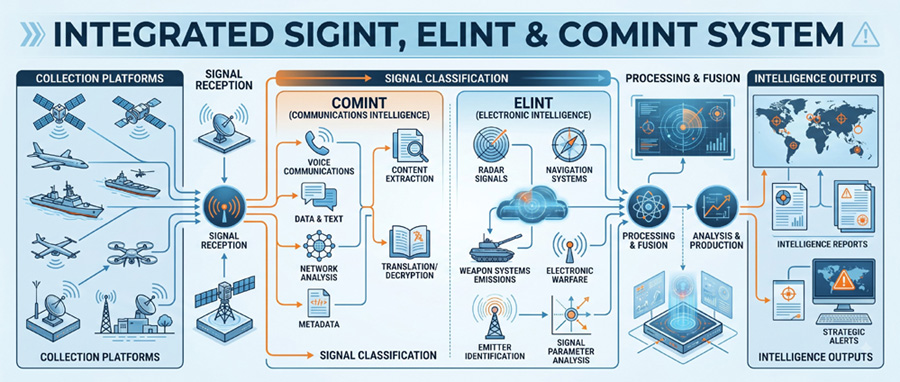
The Ultimate Guide to Electronic Intelligence (ELINT)
In modern defense and security, the invisible spectrum of radio waves and radar emissions is just as heavily contested as physical airspace or maritime borders. Understanding what is happening in that spectrum requires highly specialized technology. This is where ELINT (Electronic Intelligence) comes in.
If you want to know where an adversary's air defense systems are located, what kind of radar they are operating, or how to counter their surface-to-air missiles, ELINT is the critical discipline that provides the answers. Here is a comprehensive look at what ELINT is, how it works, and why it is a cornerstone of modern electronic warfare.
What is ELINT?
Electronic Intelligence (ELINT) is the process of gathering intelligence by intercepting and analyzing non-communications electronic signals. Rather than listening to what people are saying, ELINT focuses entirely on the machines. It looks at the emissions generated by hardware like radars, surface-to-air missile (SAM) systems, aircraft transponders, and navigational beacons. By capturing and analyzing these signals, intelligence professionals can identify the type, location, and operational status of a target.
Think of it as capturing the "electronic fingerprints" of military hardware. Because every radar system emits a unique signature based on how it pulses radio waves, ELINT can definitively tell a commander whether a blip on the horizon is a harmless weather radar or a hostile targeting system locking on.
The Two Branches of ELINT
ELINT operations are generally divided into two distinct categories based on how the intelligence will be used:
1. TechELINT (Technical ELINT): This is the deep, scientific analysis of a signal. TechELINT analysts measure the precise parameters of an intercepted radar emission to understand how the system works. This data is used to build threat libraries and design Electronic Countermeasures (ECM), such as radar jammers, to protect friendly forces.
2. OpELINT (Operational ELINT): Also known as tactical ELINT, this focuses on the immediate battlefield. It uses known radar signatures to locate enemy forces, track their movements in real-time, and determine the "Order of Battle" (the structure and disposition of enemy forces).
How ELINT Works: Decoding the Signal
When an ELINT receiver picks up a signal, it doesn't hear a voice or a data stream. Instead, it captures bursts of electromagnetic energy. Analysts and automated systems break these bursts down into specific, measurable parameters to identify the source. Here are the critical parameters ELINT systems analyze:
| Signal Parameter |
What it Measures |
Why it Matters in ELINT |
| Radio Frequency (RF) |
The specific frequency band the signal operates in (e.g., X-band, S-band). |
Helps classify the radar's purpose (e.g., early warning vs. precise weapons targeting). |
| Pulse Repetition Frequency (PRF) |
How many pulses of energy the radar sends out per second. |
High PRF usually indicates a weapon system attempting to lock onto a fast-moving target. |
| Pulse Width (PW) |
The duration of each individual radar pulse. |
Determines the radar's range and resolution capabilities. |
| Scan Pattern |
How the radar beam moves (e.g., circular, sector, conical scan). |
Reveals how the radar searches the sky and tracks its targets. |
Major ELINT Platforms
Because electronic signals behave differently depending on their frequency and the curvature of the Earth, ELINT collection requires platforms stationed across multiple domains:
1. Airborne Platforms: Specially heavily modified aircraft are the backbone of tactical ELINT. Aircraft like the RC-135U Combat Sent bristle with passive antennas capable of sweeping the spectrum to map out enemy air defenses from a safe distance.
2. Space-Based Assets: Satellites equipped with ELINT payloads can orbit over denied territory, capturing radar emissions from deep inside enemy borders where aircraft cannot safely fly. They are excellent for long-term strategic mapping of defensive networks.
3. Maritime Vessels: Naval ships, particularly destroyers and submarines, carry sophisticated ELINT suites to detect hostile coastal defense radars or the targeting radars of incoming anti-ship missiles.
4. Ground Stations: Fixed or mobile ground receivers are used to monitor border regions and protect airspace, continuously listening for the electronic emissions of approaching threats.
Why ELINT is Critical in Modern Security
In 21st-century conflict, the side that controls the electromagnetic spectrum usually wins. ELINT provides the foundational map of that spectrum.
1. Radar Warning and Self-Protection:
Every modern combat aircraft and warship is equipped with a Radar Warning Receiver (RWR). This is essentially an automated OpELINT system. When an enemy radar hits the aircraft, the RWR analyzes the signal, identifies the threat, and alerts the crew, often automatically triggering defensive measures like chaff or electronic jamming.
2. Suppression of Enemy Air Defenses (SEAD:
Before an air force can strike targets inside hostile territory, it must neutralize the enemy's air defense network. ELINT provides the exact GPS coordinates and operating frequencies of enemy SAM sites and early warning radars, allowing strike aircraft to launch anti-radiation missiles that ride the enemy's own radar beam directly back to the transmitter.
3. Ambush Prevention and Situational Awareness:
Radar systems emit energy much further than they can actually "see." By passively listening for these emissions, ELINT platforms can detect an adversary long before the adversary detects them. This allows military forces to bypass heavily defended areas or prepare for an engagement before the enemy even knows they are there.
The Future of Electronic Intelligence
As adversaries shift to advanced technologies like AESA (Active Electronically Scanned Array) radars and Low Probability of Intercept (LPI) signals, the ELINT landscape is rapidly changing. These modern radars can change their frequencies and pulse patterns thousands of times a second, making their signals incredibly difficult to isolate and identify.
To keep pace, the future of ELINT relies heavily on Artificial Intelligence and Machine Learning. Modern ELINT systems are being trained to recognize complex, shifting signal patterns in real-time, ensuring that even the most advanced, disguised radar emissions can be unmasked, cataloged, and countered.
|
|